Technical Knowledge Base

Frequently Asked Questions

Is data recovery done in the Caribbean, or do you ship drives overseas?

All hardware data recovery, cleanroom head assemblies, firmware repair, and forensic imaging are performed in-house at our laboratory in Trinidad & Tobago—serving Trinidad & Tobago, Guyana, Suriname, Barbados, Grenada, St. Lucia, St. Vincent & the Grenadines, Dominica, Antigua & Barbuda, St. Kitts & Nevis, Montserrat, Jamaica, The Bahamas, Belize, Cayman Islands, Turks & Caicos, British Virgin Islands, US Virgin Islands, Anguilla, Bermuda, Aruba, Curaçao, Bonaire, Sint Maarten, Guadeloupe, Martinique, Saint Barthélemy, Saint Martin, French Guiana, Haiti, Dominican Republic, Puerto Rico, and Cuba, and international clients without risking third-party overseas brokers.
What is an ISO Class 5 (Class 100) cleanroom—and why should a technician NEVER open my drive?

An ISO Class 5 (Class 100) cleanroom maintains fewer than 100 microscopic particles per cubic foot. Opening a drive on a standard desk or peeling back labels on Seagate Mobile SMR drives contaminates platters immediately. Stuck heads (stiction) require a Class 100 cleanroom and precision head-comb extraction tools.

What happens if the magnetic platters are scratched or damaged?

Physical scoring or head-crash rings on a platter permanently reduce or eliminate data recoverability in damaged zones. Unplug the device immediately after a drop, power surge, or clicking/grinding sound.

How does Revoco combine data recovery with digital forensic acquisition?

Even when evidence media suffers damaged heads, firmware locks, or Service Area defects, we bypass hardware faults first and acquire through hardware write-blockers to produce court-ready EnCase (E01) and Raw (DD) images on client-supplied external media.

What about data security, chain of custody, and tamper-evident VOID seals?

Devices move via vetted logistics agents and tracked international couriers, leave sealed with uniquely numbered tamper-evident VOID seals, and temporary lab copies purge 3 days (domestic) or 7 days (business/government) after closure.

How do the TT$450 evaluation fee and Graphical File List verification work?

Only the standard TT$450 diagnostic fee is credited 100% toward an approved recovery; optional Rush evaluation (+TT$450) and Cleanroom Decontamination fees are non-credited. Before closing out, you inspect a graphical File List Report to confirm critical files are recovered.

Particle-Controlled Cleanroom Bench & Sub-Micron Precision

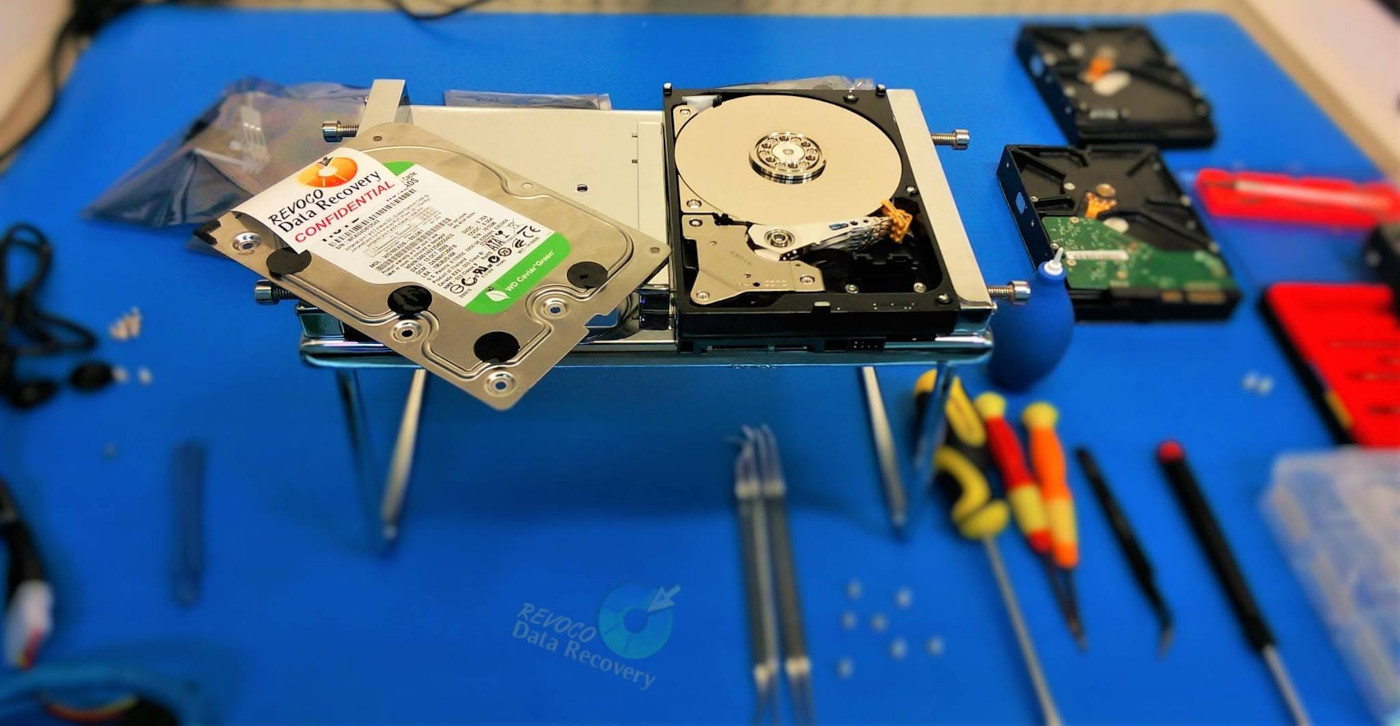
All mechanical hard drive openings and head-stack swaps are performed inside our HEPA-filtered ISO Class 5 (Class 100) cleanroom workstation—monitored with laser airborne particle counting (0 particles/L at 0.3 μm, 0.5 μm & 1.0 μm) so microscopic dust never contacts exposed magnetic platters.

Revoco ISO Class 5 Cleanroom Bench and Platter Jig
In-house ISO Class 5 cleanroom bench with precision platter & head-comb jig (monitored at 0 particles/L).
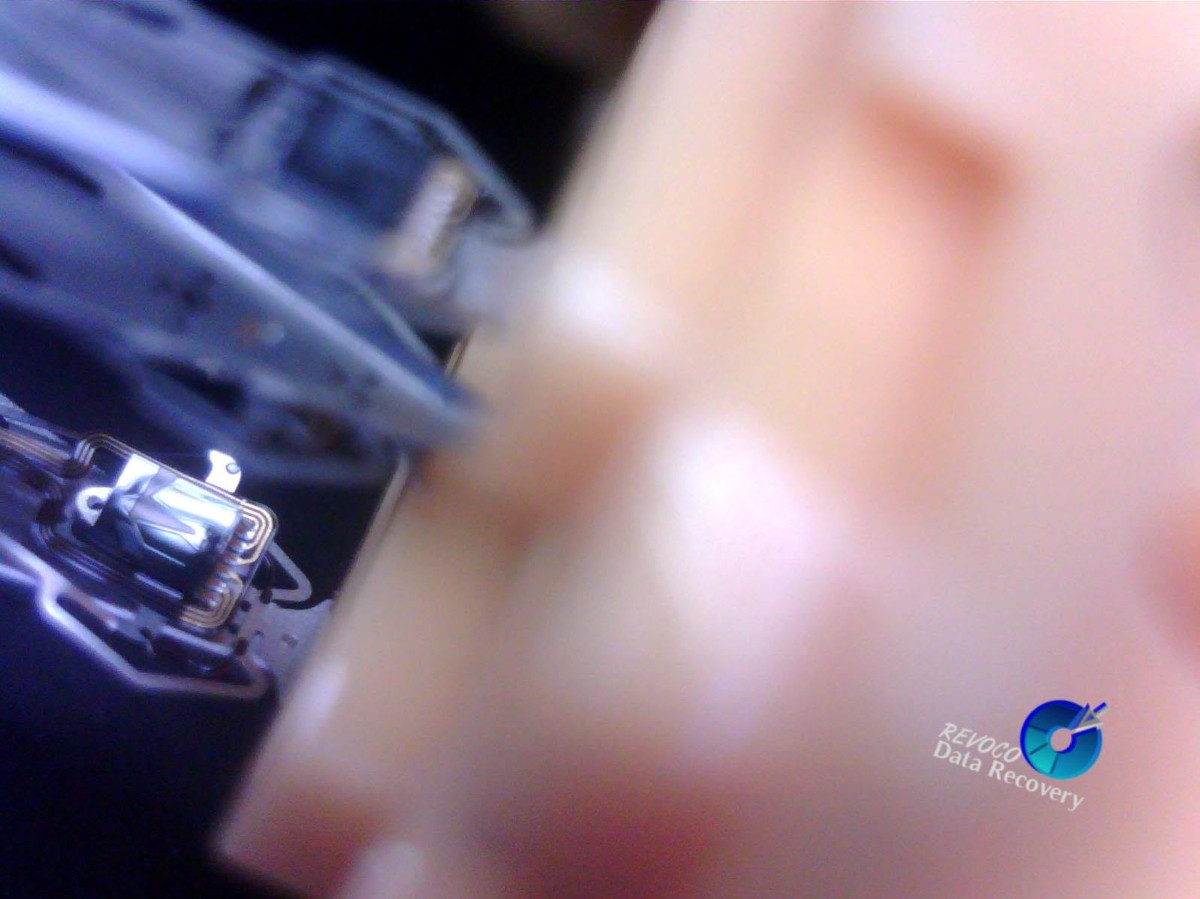
Microscopic Read/Write Head Slider Assembly
Microscopic read/write head slider hovering nanometers above the platter surface—why particle-free cleanroom air is critical.
Revoco Infographic
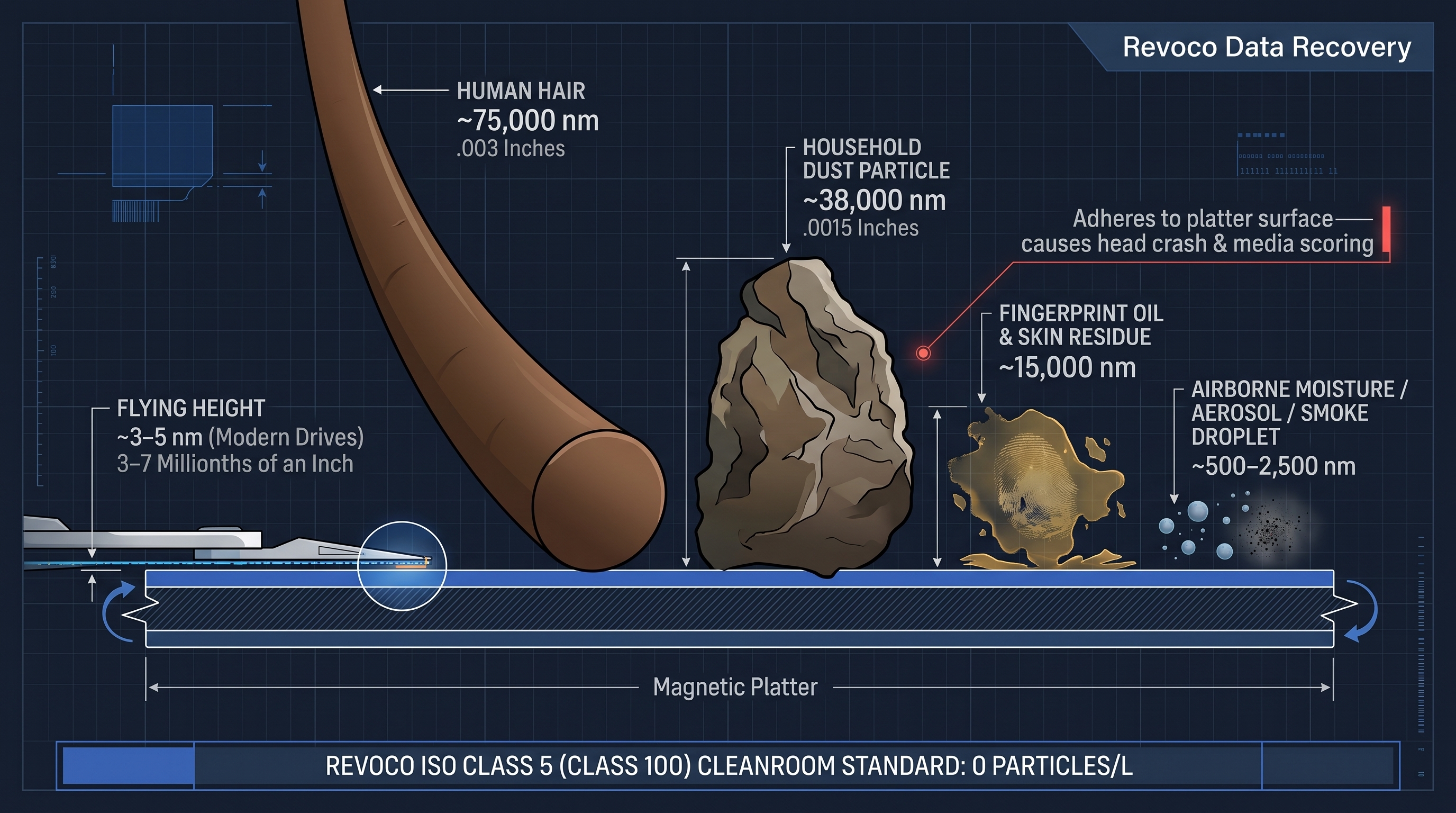
Revoco engineering scale comparison: modern read/write heads fly 3–5 nm above the platter—thousands of times smaller than airborne moisture droplets, oil aerosols, dust, or human hair. (Click diagram to zoom)
Why can't a hard drive be opened outside an ISO Class 5 cleanroom—even for a few seconds?

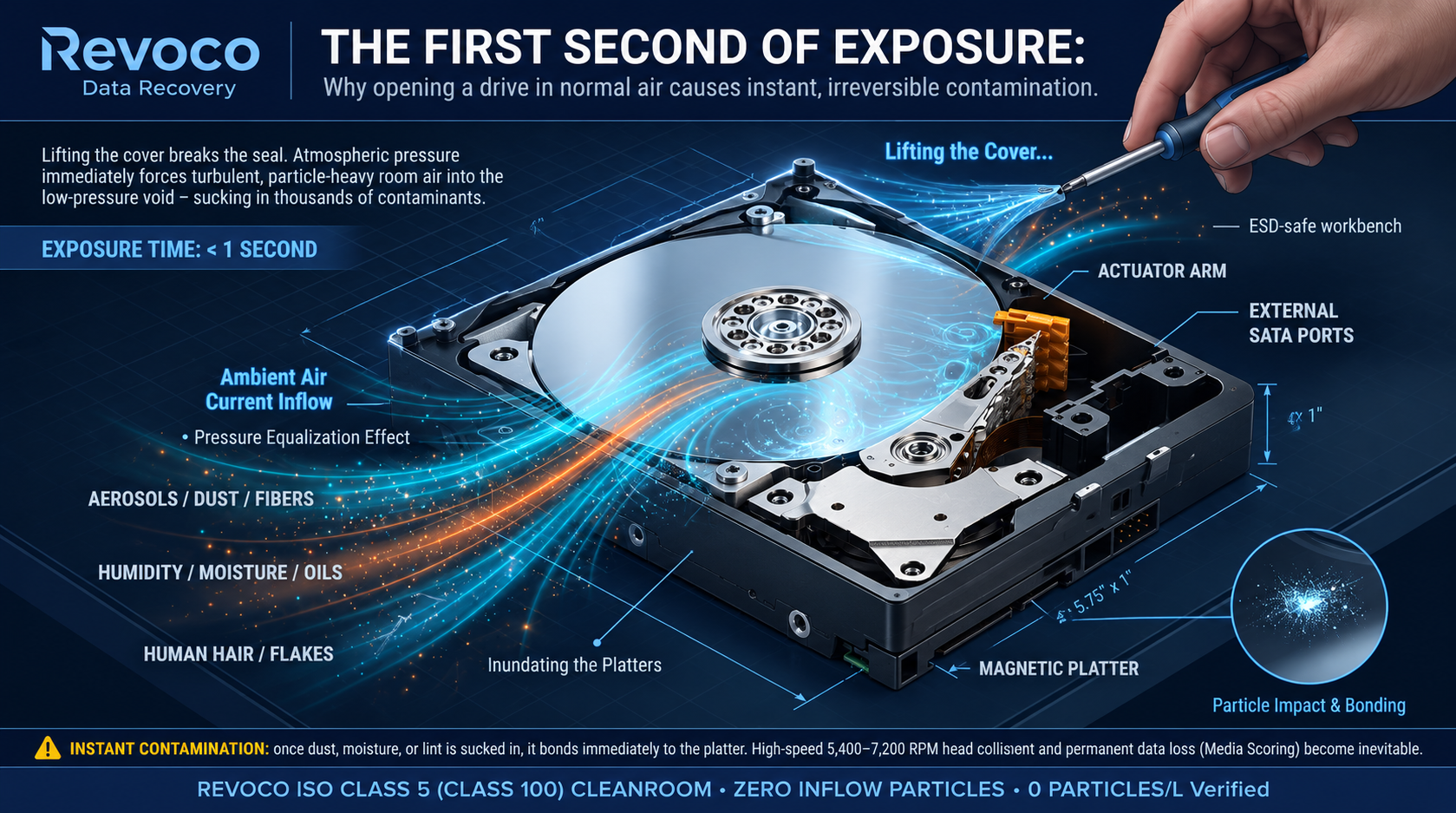
Hard drives are assembled at the factory inside particle-controlled cleanrooms. While an older ~150 GB drive had a head flying height around 10–20 nm, modern 1 TB to 20+ TB drives fly just 3 to 5 nanometers above a platter spinning at 5,400–7,200 RPM. Anything you can smell or breathe in normal office air—humidity, cooking or skin oil aerosols (500–2,500 nm), smoke, or microscopic dust (38,000 nm)—settles onto the platter and bonds to its surface via electrostatic and surface-tension forces. It does not simply blow away; when the drive spins up, the read/write head collides with the contaminant, causing a destructive head crash and permanent platter scoring.

Revoco Infographic
The first second of exposure: lifting a hard drive cover outside an ISO Class 5 cleanroom breaks the seal and pulls turbulent, particle-laden room air directly onto the magnetic platters. (Click diagram to zoom)
How do you verify your cleanroom meets ISO Class 5 (Class 100) standards, and can contaminated platters be polished?

Before opening any drive, our cleanroom workstation is verified with a laser airborne particle counter measuring 0.3 μm, 0.5 μm, and 1.0 μm channels down to 0 particles/L. If a drive was previously opened outside a cleanroom, we perform specialized non-abrasive cleanroom decontamination where feasible. We never mechanically polish or buff platters—a platter's protective diamond-like carbon overcoat is only 2–5 nm thick over a 10–20 nm magnetic layer, so abrasive polishing strips away the data layer itself and dramatically increases recovery risk.

How do I inspect and verify my recovered files before closing my case?

Before final settlement, we send you an interactive graphical File List Report showing your complete recovered folder tree, file sizes, timestamps, and header-integrity status. Try our Live Interactive Sample File List Demo ↗ (with a built-in 5-step guided walkthrough) or view the sample report screenshot.